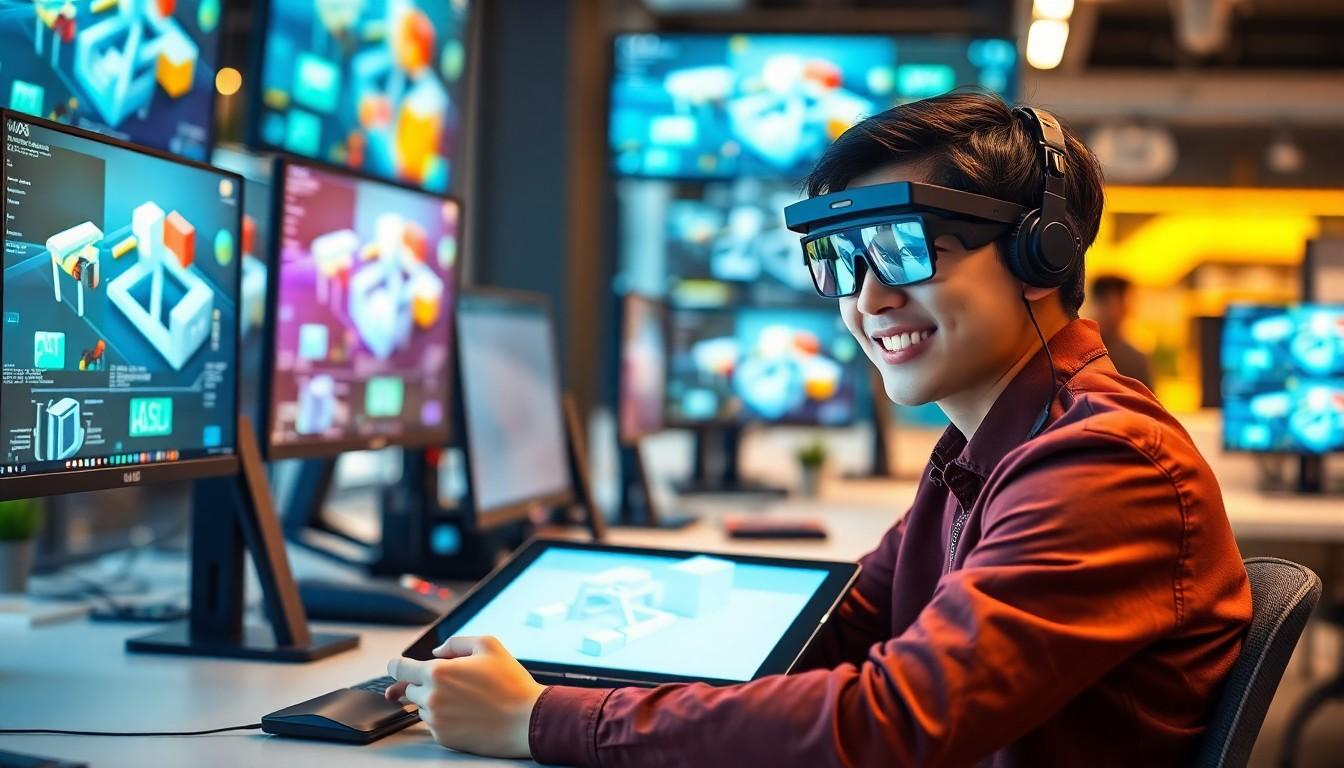
In a world where reality sometimes feels a bit too real, augmented reality developers are the wizards turning the mundane into the magical. Imagine walking down the street and suddenly spotting a dragon perched on a lamppost, or getting real-time directions projected right onto your sunglasses. These tech-savvy creators blend the digital and physical worlds, crafting experiences that make everyday life feel like a scene from a sci-fi blockbuster.
But it’s not just about flashy visuals and cool gadgets. Augmented reality developers are the architects of innovation, transforming industries from gaming to education. They’re the ones who take a simple idea and sprinkle a little digital fairy dust on it, making it come alive. If you’ve ever dreamed of being part of the next big thing in tech, stepping into the shoes of an augmented reality developer might just be your ticket to a future filled with endless possibilities.
Overview of Augmented Reality Development
Augmented reality (AR) development stands at the forefront of technology, merging digital elements with real-world environments. This integration enhances user experiences across multiple sectors.
What is Augmented Reality?
Augmented reality overlays digital information onto physical spaces. Users interact with virtual elements while engaging with their surroundings. This technology finds applications in gaming, retail, education, and healthcare. Popular examples include smartphone apps that display interactive content on surfaces or AR glasses that present real-time data. By bridging the gap between the digital and physical worlds, augmented reality enriches everyday activities.
The Role of an Augmented Reality Developer
An augmented reality developer creates immersive experiences using AR technology. Responsibilities include designing user interfaces, coding applications, and integrating 3D models. Developers often collaborate with graphic designers and project managers to ensure seamless functionality. Knowledge of programming languages such as C# or C++ is essential, while familiarity with platforms like Unity or ARKit enhances development capabilities. As the demand for engaging AR experiences grows, developers play a crucial role in shaping innovative solutions that captivate audiences.
Skills Required for an Augmented Reality Developer

An augmented reality developer needs a mix of technical and soft skills to excel in this dynamic field. Mastering these competencies ensures the creation of engaging AR experiences.
Technical Skills
Programming languages play a crucial role in AR development. C# and C++ are common choices, reflecting the requirements of various AR platforms. Familiarity with software development kits like Unity and ARKit is essential, as they provide the necessary tools for building applications. Understanding 3D modeling software boosts an AR developer’s capability to integrate virtual elements effectively. Knowledge of computer vision techniques enhances the ability to detect user environments. Experience with user interface design is imperative, as it ensures that applications remain intuitive and user-friendly.
Soft Skills
Creativity fuels innovation in augmented reality development. Problem-solving abilities allow developers to navigate challenges during the creation process. Collaboration skills are vital, as AR developers often work with graphic designers and project managers. Strong communication skills help convey complex ideas effectively to team members. Adaptability is crucial in a rapidly changing tech landscape, enabling developers to learn new technologies quickly. Time management techniques ensure project deadlines are met without compromising quality.
Tools and Technologies Used
Augmented reality developers utilize a range of tools and technologies to create immersive experiences. These resources enhance their ability to design and build applications that interact seamlessly with the physical world.
Popular AR Development Platforms
Unity stands out as a leading platform for augmented reality development. This versatile engine supports multi-platform deployment and offers rich 3D graphics capabilities. ARKit and ARCore provide developers with frameworks tailored for iOS and Android, respectively. Both SDKs streamline the creation of mobile applications with AR features. Other platforms like Vuforia enable image recognition and tracking, enhancing interaction quality. These tools empower developers to craft engaging, interactive experiences across various industries.
Programming Languages for AR Development
Several programming languages serve as foundations for augmented reality development. C# is prevalent in Unity, facilitating quick iteration and user interface creation. C++ also plays a critical role, especially in performance-sensitive applications. JavaScript is often used for web-based AR experiences, allowing compatibility with various devices and browsers. Swift is essential for development on iOS, offering smooth integration with ARKit. Familiarity with these programming languages equips developers to create seamless, dynamic AR applications that captivate users.
Career Opportunities for Augmented Reality Developers
Augmented reality developers face thriving career opportunities across various sectors due to the growing adoption of AR technology. This rise provides numerous avenues for skilled professionals.
Job Market Trends
Job market trends for augmented reality developers show a robust demand. According to recent reports, AR jobs surged by 40% between 2020 and 2023. Industries like gaming, healthcare, and education seek skilled developers to create engaging user experiences. As businesses identify the potential of AR, the need for developers with expertise in ARKit and Unity grows. Trends indicate that companies prioritize developers familiar with immersive technology, enhancing competition for well-trained candidates.
Potential Employers
Potential employers for augmented reality developers include tech giants and startups alike. Companies like Apple, Google, and Facebook lead the way, constantly innovating with AR applications. Retailers also explore AR to enhance customer engagement, employing developers to design interactive shopping experiences. The healthcare sector increasingly adopts AR for training and simulations. Other sectors such as education and entertainment are harnessing AR’s potential, creating job opportunities in diverse environments. Collaborating with graphic designers, engineers, and project managers often occurs in these roles, promoting a dynamic work atmosphere.
Future of Augmented Reality Development
The future of augmented reality development holds immense potential, with advancements shaping user interactions.
Emerging Trends
Immersive experiences dominate augmented reality’s evolution, showcasing real-time collaboration in various applications. Location-based AR experiences integrate geolocation technology, enhancing user engagement through contextual interactions. AR cloud technology emerges as a significant trend, enabling shared AR experiences across devices, thus allowing multiple users to engage with the same digital content. Custom AR solutions for businesses in retail and education gain traction, providing tailored engagements that drive customer loyalty. Artificial intelligence forms an integral part of AR as machine learning improves object recognition and user interactions, creating a seamless blend of virtual and physical realms.
Challenges and Opportunities
Developers face several challenges in augmented reality, such as ensuring cross-platform compatibility and addressing hardware limitations. Balancing user experience with technical constraints becomes pivotal, especially when designing complex applications. Competition intensifies as demand grows, necessitating continuous skill development to stay relevant in the field. Opportunities abound in healthcare, where AR facilitates surgical training and patient education, enabling innovative solutions that enhance medical outcomes. Gaming remains a lucrative sector, with AR developers creating titles that engage users in new ways. As industries embrace AR technologies, collaboration with diverse teams fosters creativity and drives innovative project outcomes.
The future of augmented reality development is bright and filled with potential. As AR continues to evolve it opens doors to new industries and applications that enhance user experiences. Developers who embrace the necessary technical and soft skills will find themselves at the forefront of this exciting field.
With the demand for AR expertise growing rapidly companies are eager to harness the power of augmented reality to engage users in innovative ways. Those pursuing a career in this dynamic landscape can expect to be part of a transformative journey that shapes the way people interact with technology and the world around them.