
Imagine walking into a hospital where doctors wear stylish augmented reality glasses, transforming patient care into a sci-fi experience. Augmented reality in healthcare isn’t just a futuristic dream; it’s revolutionizing how medical professionals diagnose and treat patients. By blending digital information with the real world, AR is making procedures smoother and more accurate—no magic wands required.
Overview of Augmented Reality in Healthcare
Augmented reality (AR) significantly enhances the healthcare field by merging digital information with physical environments. Medical professionals utilize AR tools, such as smart glasses, to visualize complex anatomical structures in real time. These tools assist doctors in performing precise surgeries, as they overlay critical information directly onto a patient’s anatomy.
Surgeons benefit from AR during operations, enabling them to see vital statistics and imaging data without diverting their attention. By improving situational awareness, this technology can lead to faster decision-making and reduced errors. Healthcare training also sees advancements through AR simulations, allowing medical students to practice procedures in a safe environment.
In addition, patient education improves with the use of AR. Patients can visualize their treatment plans and understand procedures better through interactive 3D models. This clarity enhances communication between healthcare providers and patients, fostering a cooperative treatment experience.
Data indicates that AR can expedite training processes by up to 50%, making it an invaluable tool in medical education. Furthermore, the integration of AR in rehabilitation programs provides guided therapy, motivating patients through gamified experiences.
Examples of successful AR applications include systems used for vein visualization, assisting nurses in finding veins quickly and accurately. Innovations like these showcase AR’s ability to streamline patient care, ensuring better outcomes and higher satisfaction levels. Overall, AR’s capabilities continue to shape the future of healthcare, transforming how professionals diagnose, treat, and educate patients.
Applications of Augmented Reality
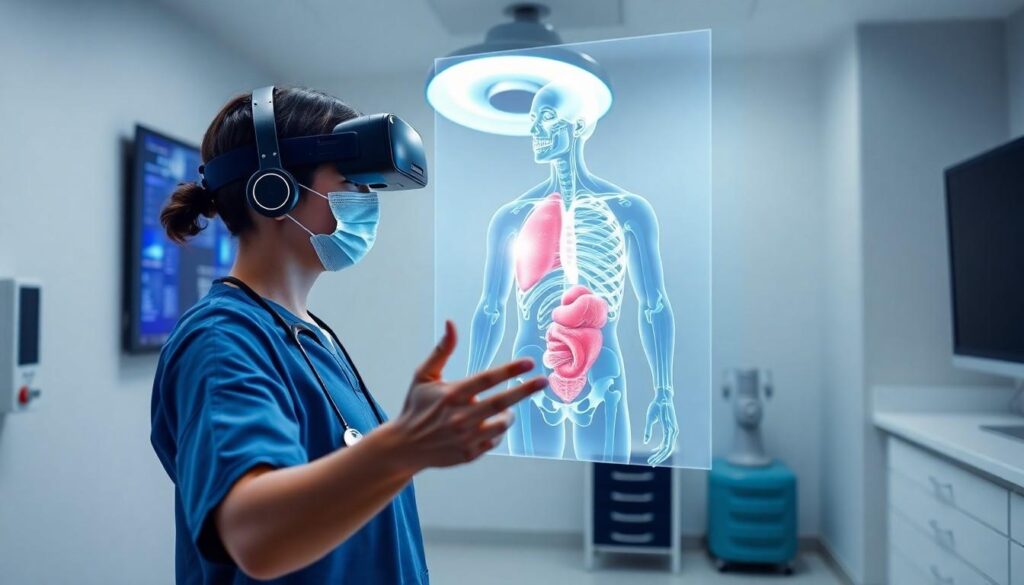
Augmented reality (AR) provides innovative solutions that transform various aspects of healthcare delivery. From surgical training to patient education, AR enhances both the learning experience and patient outcomes.
Surgical Training and Simulations
AR technology revolutionizes surgical training and simulations. Medical students and residents utilize immersive AR platforms to practice intricate procedures in a risk-free environment. These simulations allow learners to visualize real-time 3D models of anatomy. Engaging with these models boosts understanding of complex surgical concepts. Research indicates that AR can shorten training durations by 50%. As a result, healthcare professionals gain confidence and proficiency before performing actual surgeries.
Patient Education and Engagement
AR facilitates enhanced patient education and engagement. Using AR applications, patients can explore interactive 3D models to better understand their conditions. Visualizing treatment plans becomes easier, fostering clearer communication between healthcare providers and patients. Enhanced comprehension helps patients actively participate in their care decisions. Furthermore, AR can simplify complex medical language, making it accessible. Engaged patients tend to report higher satisfaction levels, contributing positively to overall healthcare experiences.
Benefits of Augmented Reality in Healthcare
Augmented reality (AR) offers a multitude of benefits that enhance various aspects of healthcare. Its integration leads to more effective patient care.
Enhanced Visualization and Precision
AR technology significantly improves visualization during medical procedures. Surgeons benefit from real-time overlays of digital information on a patient’s anatomy. This instant access to critical data propels accuracy, allowing for precise incisions and interventions. Studies reveal that AR can increase surgical success rates, minimizing risks. Visualizing complex anatomical structures helps practitioners navigate intricate environments, resulting in improved situational awareness. Furthermore, AR tools assist medical staff in identifying anomalies that may not be visible otherwise, directly enhancing surgical outcomes and patient safety.
Improved Patient Outcomes
Patient outcomes improve considerably through AR applications. Engaging patients with interactive 3D models fosters a deeper understanding of treatment plans. Studies indicate that patients who utilize AR for education report increased satisfaction and adherence to treatment. Visualizing procedures before they occur builds trust between healthcare providers and patients. Additionally, AR’s integration in rehabilitation programs motivates individuals through gamified exercises, promoting recovery. This technology has proven effective in creating tailored experiences, guiding patients through therapy while tracking progress. Enhanced understanding and engagement help ensure lower complication rates and higher overall satisfaction in healthcare experiences.
Challenges and Limitations
Augmented reality in healthcare faces several challenges that can hinder its widespread adoption. These hurdles include technological barriers and ethical considerations, each impacting AR’s effective implementation in medical settings.
Technological Barriers
Limited infrastructure poses a significant challenge. Many healthcare facilities lack the necessary hardware and software for AR deployment. Integration issues with existing systems complicate workflows. Additionally, learning to use new technology requires training, which demands time and resources, creating reluctance among staff. Connectivity problems can also disrupt AR applications, leading to potential lapses during critical procedures. Moreover, high costs associated with AR technologies can deter investment, particularly for smaller institutions. Organizations must address these barriers to harness AR’s full potential in enhancing patient care.
Ethical Considerations
Ethical challenges arise when implementing augmented reality in healthcare. Patient privacy requires careful handling, as AR tools often use sensitive health information for data overlay. Ensuring security against data breaches remains a priority. Additionally, informed consent becomes complex, as patients might not fully understand how AR applications will be used during their treatment. Misinterpretations of AR information can lead to misinformation, which affects decision-making. Moreover, equity in access raises concerns; not all patients or healthcare providers benefit equally from AR advancements. Ethical frameworks are essential to address these issues, maintaining trust and integrity in patient care.
Future Trends in Augmented Reality
Augmented reality is poised to reshape healthcare further in the coming years. Innovations in AR technology promise to improve surgical precision and patient outcomes, pushing the boundaries of existing applications. Experts anticipate the rise of AR-driven telemedicine, allowing healthcare providers to guide surgery remotely with real-time data overlays.
Integration of AI with AR enhances the potential for personalized medicine. Health professionals can analyze patient data more comprehensively, delivering tailored treatment plans based on individual needs. The collaboration between AI and AR is expected to streamline workflow, minimizing errors and maximizing efficiency in hospitals.
Moreover, improving accessibility to AR tools will expand their use in rural and underserved areas. AR applications can bridge gaps in healthcare by providing remote consultations and advanced training for local practitioners. Wider adoption of AR technologies across various medical disciplines is likely to promote equity in healthcare access.
Training in medical education will continue evolving through AR applications. Medical students are expected to encounter more realistic simulations, fostering hands-on experience in a controlled environment. Studies project that AR can lead to significant improvements in learner engagement and knowledge retention.
Patient engagement will transform further, with AR becoming a standard tool for patient education. Visualizing complex medical information through immersive 3D experiences enhances understanding, reducing anxiety related to procedures. This trend indicates a shift toward more interactive healthcare experiences.
Emerging ethical standards will guide the development and use of AR technologies. Ensuring patient privacy and maintaining trust in AR applications is crucial for widespread acceptance. As healthcare institutions navigate these challenges, adherence to ethical guidelines will play a vital role in shaping the future landscape of AR in healthcare.
Augmented reality is revolutionizing healthcare by enhancing how medical professionals diagnose and treat patients. Its ability to overlay critical information in real time allows for more precise surgeries and improved training for future healthcare providers. As AR continues to evolve, it promises to make healthcare more accessible and efficient, ultimately leading to better patient outcomes.
The challenges associated with AR’s integration into healthcare are significant but not insurmountable. Addressing these barriers will be crucial in maximizing the technology’s potential. With ongoing advancements and a focus on ethical considerations, augmented reality is set to play a pivotal role in shaping the future of healthcare, fostering deeper patient engagement and transforming medical practices.