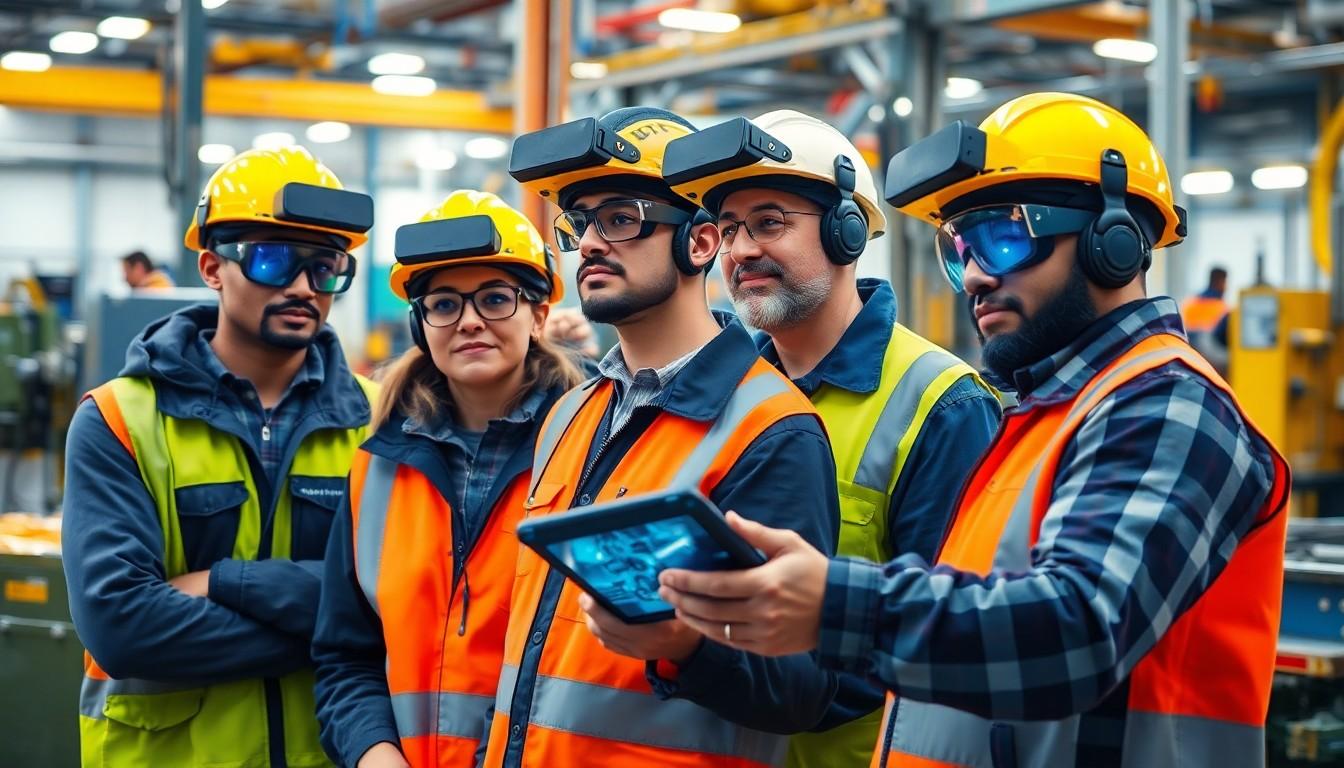
Imagine walking into a manufacturing plant where machines don’t just hum—they talk. Augmented reality (AR) is revolutionizing the industry, transforming how workers interact with their environment. It’s like giving them a superpower, enabling them to visualize complex data right before their eyes. Forget about squinting at blueprints; with AR, the future of manufacturing is as clear as a pair of high-definition glasses.
Overview of Augmented Reality in Manufacturing
Augmented reality (AR) revolutionizes manufacturing by enhancing productivity and improving accuracy. Workers interact with their surroundings in innovative ways, visualizing critical data without relying on physical blueprints. Real-time analytics facilitate seamless communication between operators and machinery, leading to quicker decision-making.
AR applications in manufacturing include assembly assistance, equipment maintenance, and training programs. For instance, assembly lines benefit from step-by-step visual guidance, reducing errors and time spent on corrections. Maintenance tasks become more efficient when technicians access overlaid instructions and diagnostic data directly in their field of vision.
Multiple studies indicate that AR can reduce error rates by up to 40%. Such improvements lead to increased productivity, ultimately forecasting a potential annual economic impact of $361 billion across various industries by 2030. Companies implementing AR report higher employee satisfaction due to reduced complexity in their tasks.
Customization of AR solutions offers flexibility tailored to specific operational needs. Organizations can integrate AR with existing systems, ensuring that the technology complements established workflows. Compatibility with Internet of Things (IoT) devices further enhances capabilities by providing real-time data from interconnected machines.
As manufacturers adopt AR technology, workforce training also evolves. New employees engage with immersive simulations that mimic real-world scenarios, promoting better retention of information. This hands-on approach accelerates the learning curve, preparing workers for the demands of modern manufacturing environments.
Future prospects for AR in manufacturing seem promising. Innovations in AR technologies continue to develop, paving the way for entirely new manufacturing paradigms. With its potential to streamline processes and reduce costs, AR stands as a significant player in the future landscape of the manufacturing industry.
Benefits of Augmented Reality
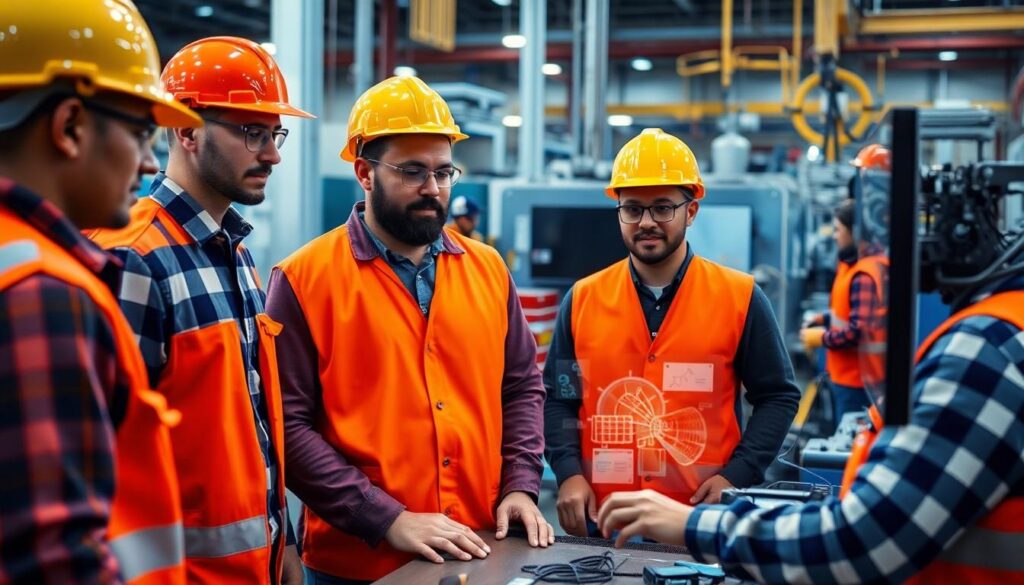
Augmented reality (AR) delivers significant advantages in the manufacturing sector, enhancing productivity, training effectiveness, and collaboration among teams.
Improved Efficiency
AR streamlines workflows, allowing workers to access real-time data overlays. Operators navigate complex tasks with minimal error, boosting overall efficiency. Up to 40% error reduction enhances precision in operations. Assembly lines see increased throughput as AR supports faster decision-making without interrupting workflow. The seamless integration of AR with existing systems leads to enhanced communication between machines and personnel, ensuring everyone remains informed.
Enhanced Training
Training programs utilizing AR foster immersive learning experiences for new employees. Workers engage in hands-on simulations, significantly improving knowledge retention. Companies report quicker adaptation to processes, reducing the time needed to reach full productivity. With AR, visual instructions accompany training, clarifying complex procedures. This innovative approach empowers employees to become confident and skilled in their roles, contributing to a more competent workforce.
Better Collaboration
AR enhances teamwork by providing a shared platform for visualizing data. Team members collaborate more effectively, receiving real-time insights and feedback on projects. Virtual overlays allow individuals to see the same data simultaneously, significantly improving communication. Employees can troubleshoot equipment issues together, streamlining problem-solving processes. The technology fosters a culture of collaboration, aligning team efforts with company goals for increased operational success.
Key Applications of Augmented Reality in Manufacturing
Augmented reality (AR) plays a crucial role across various manufacturing processes, enhancing efficiency and accuracy. The key applications include maintenance and repair, production planning, and quality assurance.
Maintenance and Repair
AR simplifies maintenance tasks by overlaying vital data directly onto equipment. Technicians access real-time information, such as schematics and operational parameters, enhancing troubleshooting efficiency. This technology can reduce downtime significantly by enabling remote expert assistance through AR interfaces. Moreover, studies show that AR can cut maintenance time by up to 30% when used alongside traditional methods. On-site workers benefit from more effective training during maintenance procedures, leading to improved skill development and knowledge retention.
Production Planning
Production planning gains clarity through AR by visualizing workflows and resource allocation. Managers can display critical information like schedules and inventory levels within the employee’s field of vision. Enhanced visualization reduces planning errors and streamlines communication among teams. Furthermore, AR facilitates rapid adjustments to production schedules based on real-time data. Companies leveraging AR in production planning report decreased lead times, contributing to overall operational excellence and increased customer satisfaction.
Quality Assurance
AR improves quality assurance processes by providing real-time feedback on products being manufactured. Inspectors utilize AR to visualize quality metrics and compliance standards directly on the assembly line. This immediate access to information minimizes errors before products reach customers. Enhanced visual guidance can also help in conducting inspections faster, leading to more efficient quality control processes. By integrating AR into quality assurance, manufacturers can achieve lower defect rates and maintain higher production standards.
Challenges and Considerations
Adoption of augmented reality in manufacturing comes with several challenges and considerations that companies need to evaluate.
Technical Limitations
Technical limitations present significant hurdles in implementing AR. Hardware restrictions can affect the quality of AR experiences, with some devices struggling to support high-resolution overlays. Software compatibility issues may arise when integrating AR solutions with existing systems. Connectivity problems can hinder real-time data access, slowing down processes. Additionally, limited battery life on AR devices can disrupt operations, requiring timely recharging for consistent use. Organizations must address these challenges to fully realize AR’s potential in manufacturing.
Cost Implications
Cost implications can be substantial when adopting AR technologies. Initial investment in AR hardware and software often incurs significant upfront costs, creating a barrier for smaller manufacturers. Integration with existing systems might also involve additional expenses, requiring specialized expertise. Long-term maintenance and updates for AR systems can add to overall costs. However, potential returns on investment from increased productivity and reduced error rates present a compelling case for many companies. Stakeholders need to weigh these financial factors against the anticipated benefits of implementing AR solutions in their operations.
Future Trends in Augmented Reality in Manufacturing
Anticipated advancements in augmented reality (AR) technology will reshape the manufacturing landscape. Companies are increasing investments in AR to achieve greater operational efficiency. Enhanced integration with Internet of Things (IoT) devices enables better data visualization. Workers will utilize AR to access real-time information, reducing dependency on conventional manuals.
Growth in artificial intelligence (AI) coupled with AR will foster smarter decision-making. By analyzing vast data sets, systems will provide actionable insights instantly. Businesses will experience a decline in error rates, reinforcing quality assurance practices. Research shows that an economic impact of $361 billion across industries is feasible by 2030.
In training contexts, AR’s immersive simulations will revolutionize onboarding processes. New employees will engage in hands-on learning experiences that enhance retention of information. Experienced workers will benefit from continuous skill development in an evolving technological environment.
Customization of AR applications is set to rise, allowing solutions to cater to unique operational needs. Flexibility will become a crucial aspect in integrating AR with existing manufacturing systems. Furthermore, enhancements in hardware capabilities will improve the overall user experience.
Challenges associated with AR implementation will persist, including connectivity issues and costs. Despite barriers, companies are recognizing the long-term benefits of AR, including increased productivity. The commitment to overcoming technical hurdles will lead to widespread adoption.
Overall, the future of AR in manufacturing presents exciting opportunities for innovation. Continuous technological advancements will drive efficiency, shaping a new manufacturing ethos. As organizations embrace AR, they will ultimately transform their operational strategies and elevate industry standards.
Augmented reality is set to redefine the manufacturing landscape by enhancing productivity and accuracy. As companies embrace this technology, they’re not just streamlining operations but also fostering a culture of collaboration and innovation. The integration of AR with existing systems and IoT devices will continue to drive efficiency and improve decision-making processes.
While challenges remain, the long-term benefits of AR adoption present a compelling case for manufacturers. The focus on customization and advancements in hardware will further enhance user experiences. As AR technology evolves, it promises to unlock new possibilities for training and operational excellence, paving the way for a more efficient and effective manufacturing future.